























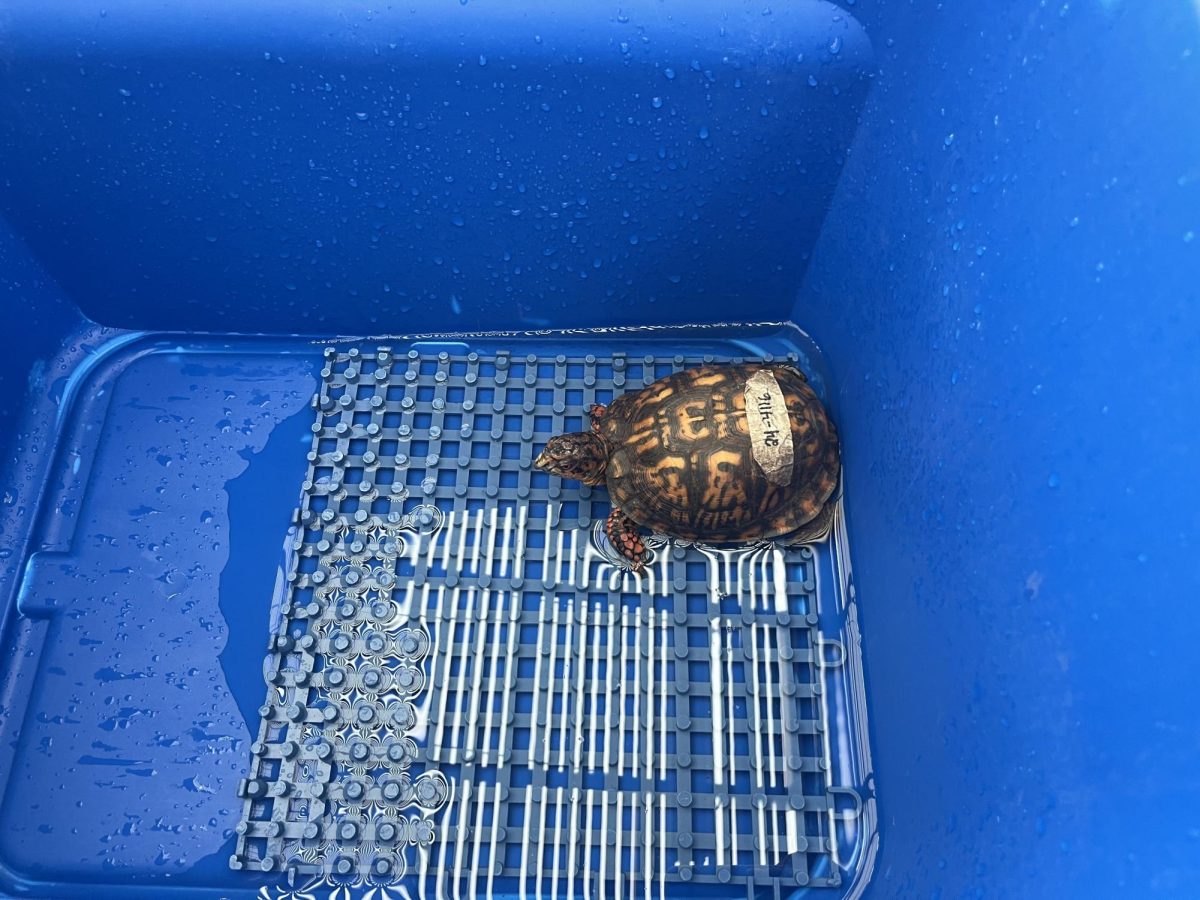
BRIDGEWATER, Va. – Senior environmental science major Riley McDonald heads to the McKinney Center on Tuesday morning for his routine checkup on the six Woodland Box Turtles he and other students at Bridgewater oversee. First, McDonald does a visual examination of each turtle for any clear signs of distress. Once visual confirmation provides the “all-okay,” he checks their body masses and weight. Shortly after, a delicate mist of water to each individual turtle is distributed, ensuring a moist environment. Before departing, McDonald makes sure that all the water-filled paint trays in each sanctuary are sufficiently full.
This is a typical morning for McDonald and the other students who participate in the turtle rehabilitation program. According to the Wildlife Center of Virginia, the collaboration between the college and the wildlife center has been in the works for several years. Bridgewater alum Ed Clark is the wildlife center President Emeritus and Co-Founder, so he was a key player in initiating this partnership.
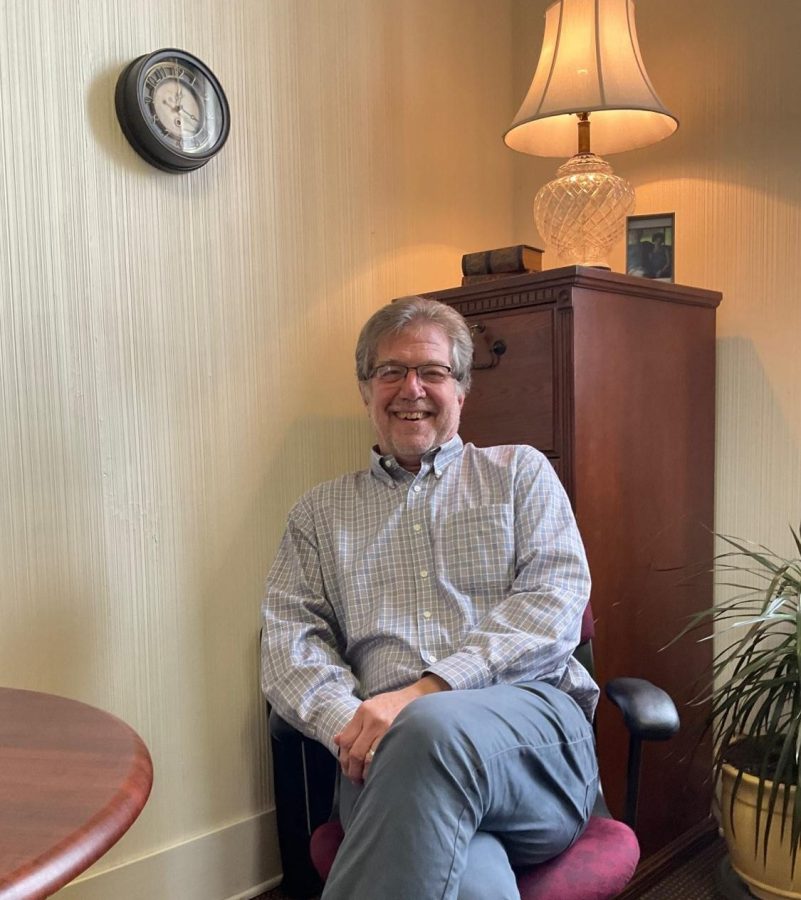
Associate Professor of Biology and Environmental Science, Tamara Johnstone-Yellin, said the hope in this collaboration is for wildlife biology students and pre-veterinary students to have a controlled environment where they can learn how to handle wildlife in an ethical and safe manner.
How to get involved
McDonald said to obtain the status of a turtle caretaker you must first take the introduction to wildlife rehabilitation course with Johnstone-Yellin. For McDonald, this course was a one-credit class and met once a week every Friday of the Fall 2025 semester.
“And then once you complete the course and get a satisfactory grade, you have the option to, you could work with the turtles,” McDonald said. “So this semester it’s a practicum, it’s called Intro to Wildlife Rehab Practicum.”
Johnstone-Yellin said the seminar class was taught by her, but also brought in professionals from the wildlife center to cover general husbandry care, pathology testing, raptor rehab, reptile rehab and euthanasia.
“I had 18 [students] in the seminar and then 7 this semester for the practicum,” Johnstone-Yellin said. “Because we’ve been doing this piecemeal, we only had so many students that could fit it into their schedule.”
Senior data science analytics major Ryan Duncan began his journey with rehabilitation long before he took Johnstone-Yellin’s course. Duncan began volunteering at the wildlife center a year prior, so when the time came to take the practicum course, he was already legally approved to handle the turtles.
“I started there and it’s because I just wanted to,” Duncan said. “It seemed like something I’d be interested in.”
Duncan said he had worked with the turtles all summer at the wildlife center, so he had a comprehensive understanding of the procedures in taking care of them and feeding them.
The ins and outs of box turtle care
Sophomore biology major, Morgan Lynn, said that seven days a week there are one to two shifts, depending on the turtles’ feeding schedules, to help regulate and maintain their health.
“So we only feed them on Monday, Wednesday and Friday because they fast in between feedings and then they fast over the weekend,” Lynn said.
She said on Tuesday, Thursday and Saturday, students go through and monitor how much each turtle has actually consumed.
Johnstone-Yellin said the turtles consume a slurry-mush of material composed of dark leafy greens. They are also given something called a primate biscuit, which ensures that they receive all the nutrients they might need.
According to Mazuri Exotic Animal Nutrition, primate biscuits contain a slew of ingredients, but those most familiar include ground corn, soybean oil and ground wheat.
Lynn said the program has their own grow fridge, which allows for both plants and cherry tomatoes to grow. These are fed to the turtles, along with a changing rotation of carrots, broccoli, apples or oranges.
“And then we just do basic, like, house cleaning stuff, cleaning out their enclosures, spot cleaning everyday that we go in there,” Lynn said. “We make sure they have a soak bin in there as well, so that if they want to soak in their own time, they can.”
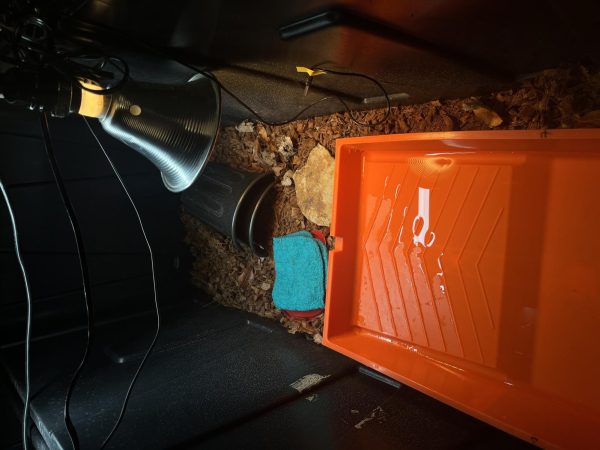
Johnstone-Yellin said the base of each turtle enclosure is a finer substrate of coconut core, often used in gardening. This is ground up and mixed together with larger bark chunks.
“And we mix that together in a certain ratio,” Johnstone-Yellin said. “So we put a couple inches in there…it allows them to burrow down, gives them a nice substrate for them to work through.”
McDonald said on Fridays and Sundays, the turtles engage in “soak days.”
“Basically, we take them out of their enclosure, put them in another tub, soak them so they can move around,” McDonald said.
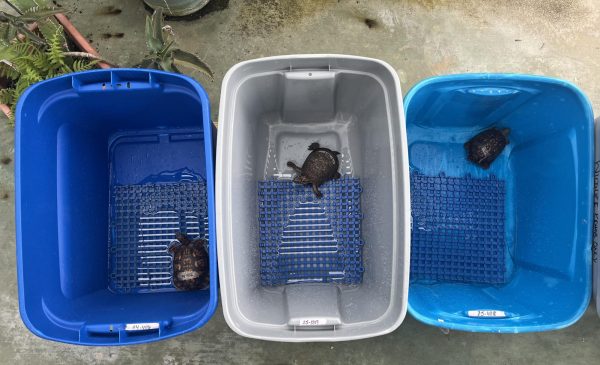
Lynn said on Fridays and Sundays there is a shift for taking the turtles out of their soak bins and disinfecting them for the next use.
Preparation for future endeavors
Lynn hopes to become a veterinarian and she said her experience with these turtles is a very good starting point.
“It’s kind of like you get to work with them in a learning environment that’s very beneficial for all of us,” Lynn said.
McDonald said he believes his experience with the turtles will help him build connections with people in this similar field, as well as with professors he looks up to.
According to Structural Learning, hands-on learning is beneficial for student engagement because it shifts from passive reception to active participation. This enhances knowledge retention and allows students to form stronger connections with what they are physically interacting with.
“I think it covers a lot of bases. One, the actual handling experience because it’s gonna be different than, you know, handling domestic animals right?” Johnstone-Yellin said. “This is a case where we want to be as hands off as possible, so it helps them learn what is appropriate handling for wildlife. It teaches them about the wildlife that’s out there.”