



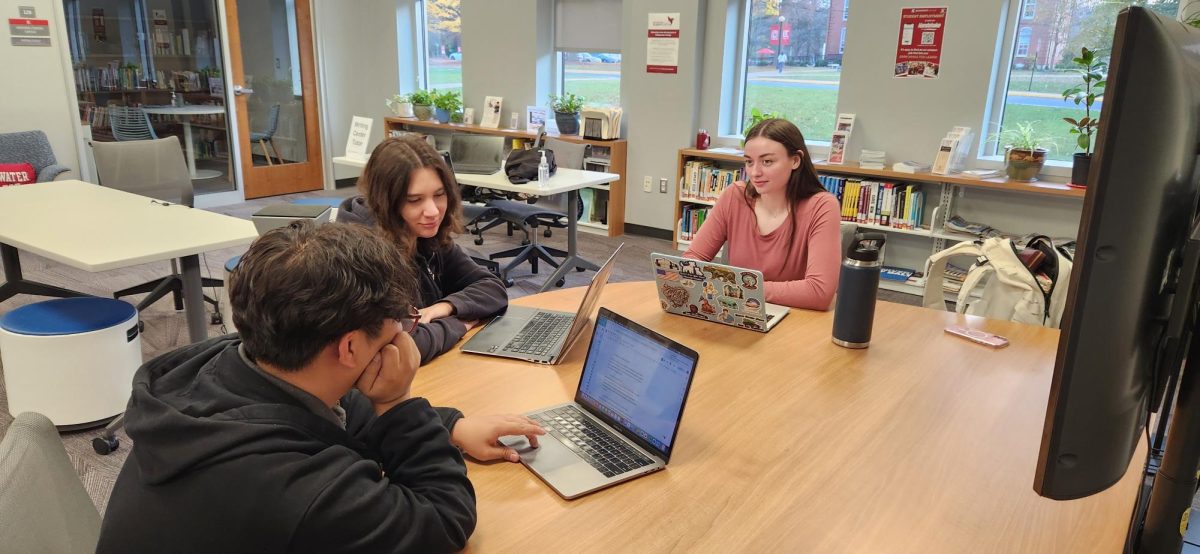












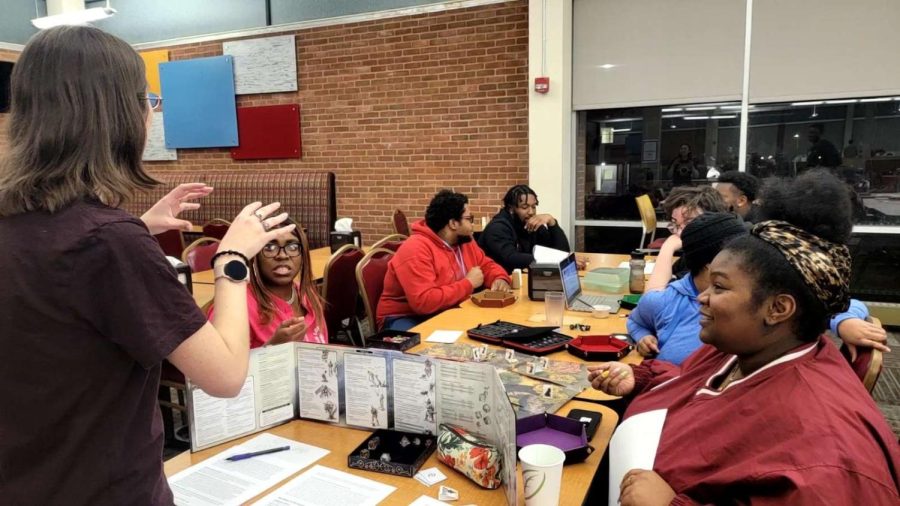






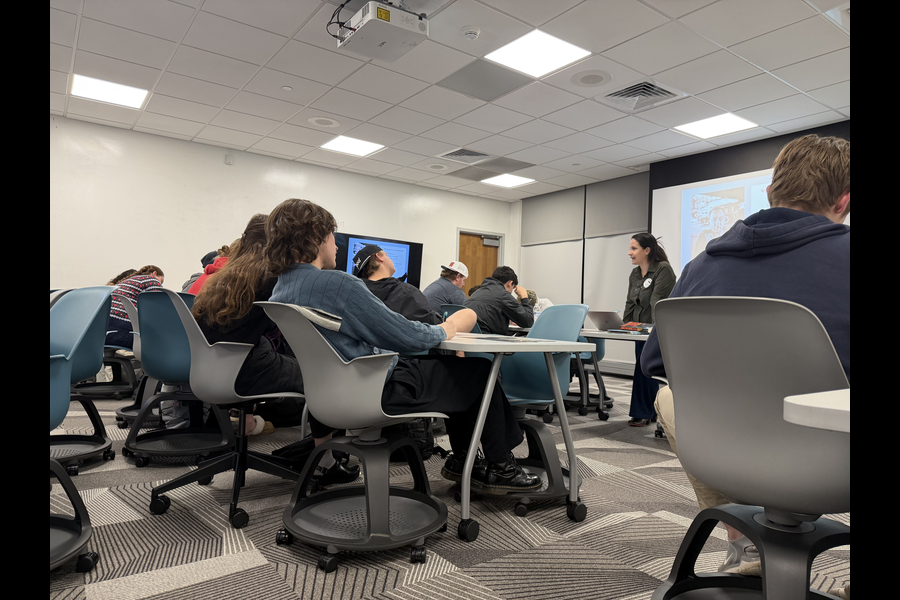
BRIDGEWATER, Va. – Students learned about Martin Luther King Jr.’s supportive friendships at the interactive teach-in on Feb. 19 at 7 p.m. in the Forrer Learning Commons (FLC) hosted by Assistant Professor of English Vanessa Rouillon.
“The idea of a teach-in is not so much a lecture and not so much a teaching experience,” Rouillon said. “It’s supposed to be a moment in which a teacher invites students to participate.”
The event was supposed to happen back in January during the week of Martin Luther King Jr. Day as part of the college’s celebrations but had to be postponed due to the bad weather. It was instead included as a Black History Month celebration.
The event, titled “Stitched Together in the Struggle: Examining Dr. Martin Luther King’s Friendships in Service of the Movement” was free and open to both students and the public. Rouillon presented several different historical images and read passages from several books that focused on the topic.
“He was friends with not only black Americans but he was also friends with white Jewish guys, with white guys who also supported him,” Roullion said.
The talk focused on King’s close personal friendships and other relationships. There was a specific emphasis on his relationship with his wife, Coretta Scott King, his confidant, Mahalia Jackson, and his relationship with several African American poets like Langston Hughes.
Roullion read passages from letters exchanged between King and his wife, contained in “Letters From Black America” by Pamela Newkirk, in which he expressed how much she helped him and supported him. She asked students to consider how the relationship between them was influential to his public image.
“I learned more about his personal life because she really dived into that,” BC student Gracie Brammer said. “I mean I didn’t know his wife was so into it, which she was.”
The talk also emphasized the influence art such as music and poetry had on King and his work. Roullion said King would often call his close confidant Jackson when he was struggling and ask her to sing to him. Jackson was also the one who prompted King to start his “I Have a Dream” speech at the 1963 March on Washington.
Brammer said her favorite thing she learned at the teach-in was how much poetry, especially by black authors, meant to King and his movement.
Roullion talked about how famous African American poet Langston Hughes was a large influence on King and explained how he would ask Hughes if he could borrow parts of his writing to use in his speeches.
During the teach-in, sticky notes were handed out to everyone and there were several opportunities for people to write down their thoughts or feelings on different topics. For example, questions asked how the women in King’s life supported him and how poetry influenced his speeches.
The teach-in acknowledged the work of Carter G. Woodson and how he founded Black History Month. An article from ASALH states that Woodson started the idea of a black history celebration in the 1910s and worked toward the national celebration of Black History Month in the 1960s. While Woodson passed away before Black History Month could become a national celebration, his work was influential in instituting it.