





































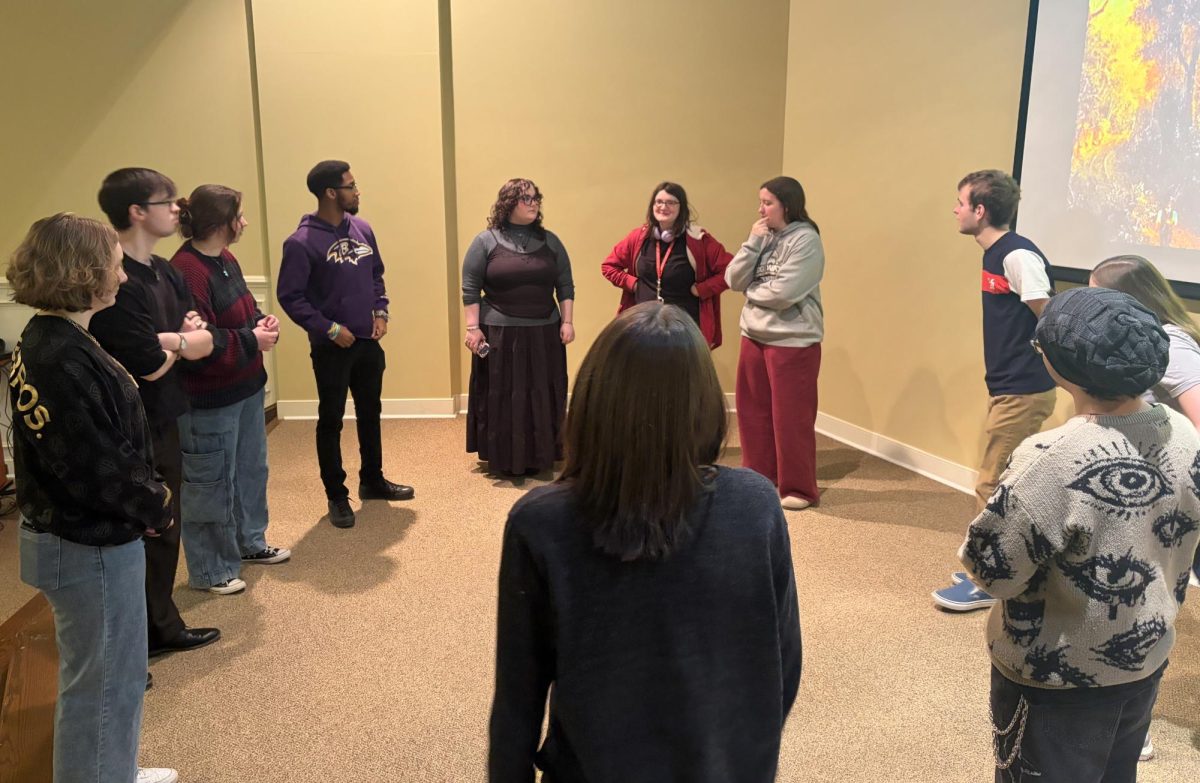
BRIDGEWATER, Va. – Kayla Stanley took a deep breath, locked eyes with the audience, and cleared her head. The cast quickly asked the audience members to pick a number, one through thirty. The audience all began shouting, several different numbers being thrown around, but one stuck out in particular, eight. Stanley grabbed her glove and sat in the center of the stage, surrounded by the audience. She took another deep breath, posed, and began her monologue.
This scene was part of the Pinion Players’ performance of “Too Much Light Makes the Baby Go Blind” by Greg Allen and the Neo-futurists. According to the Bridgewater College website, the play is an ensemble experience that consists of 30 plays completed over 60-minutes, with a timer counting down. The plays are completed in a random order, often with the audience influencing which is chosen and interacting with the actors during the performance.
This performance was a part of the Pinion Players’ recent surge of increased participation in performances and event hosting.
Club Origins
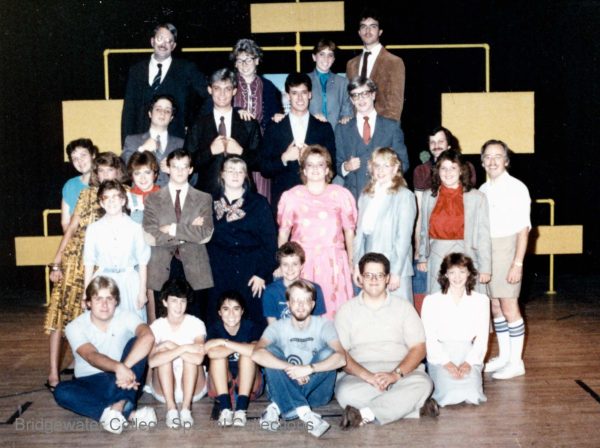
According to the Bridgewater College Digital Commons, the Pinion Players club originated as the “Curtain Club of Bridgewater College” in the fall of 1937. Other groups on campus had done performances prior to the foundation of the club, such as the Shakespeare club, which formed around 1907. The club changed its title to Pinion Players in 1963 when Bridgewater College employed Frank Fuller, the first full-time theatre professor at the college.
The club was then advised by Ralph MacPhail Jr. from 1972 to 2005, and is now advised by Scott Cole. Bridgewater College theatre provides both a theatre major and the Pinion Players club. The program, formally known as Theatre at Bridgewater College, puts on shows and hosts classes. The Pinion Players club hosts activities and other events. The members of the club are also the primary group of actors participating in the shows sponsored by Theatre at Bridgewater College.
Recent lack of club presence
Laine Anthony, President of the Pinion Players Club, said that when she began attending Bridgewater College in 2023, the club didn’t seem very interesting or open.
“It felt pretty exclusionary, like you would only join if you were super into theater or if you were already pretty heavily involved,” Anthony said.
Kayla Stanley, Social Media Coordinator for the Pinion Players, said she remembers seeing the Pinion Players club at the campus connections fair when she arrived in the fall of 2023. Stanley said that the club hosted events, but not consistently, and they weren’t popular.
“I remember seeing there wasn’t really a set date for the next event, or a certain time that I could get involved,” Stanley said. “They were a club, but there weren’t a lot of engagement opportunities.”
Anthony said the club’s intention for revival began in 2024 when she became vice president under the former president, Elizabeth Melton.
“She had kind of proposed that to me as like a hostile takeover,” Anthony said. “The club had been pretty inactive and so she wanted to revive it and she wanted my help, but it didn’t really come to fruition until this year when I was elected president.”
The changes
Anthony said the club had the goal this year to start hosting more special events. The club executive board and Cole talked about hosting at least monthly events, whether something small or large, to increase engagement.
Anthony said the intention of hosting more events is to make it more accessible to students. More events hosted means more opportunities for students to attend, which increases the likelihood of that event aligning with their schedules.
Stanley said the club is hosting events more consistently and widening the variety of events it hosts.
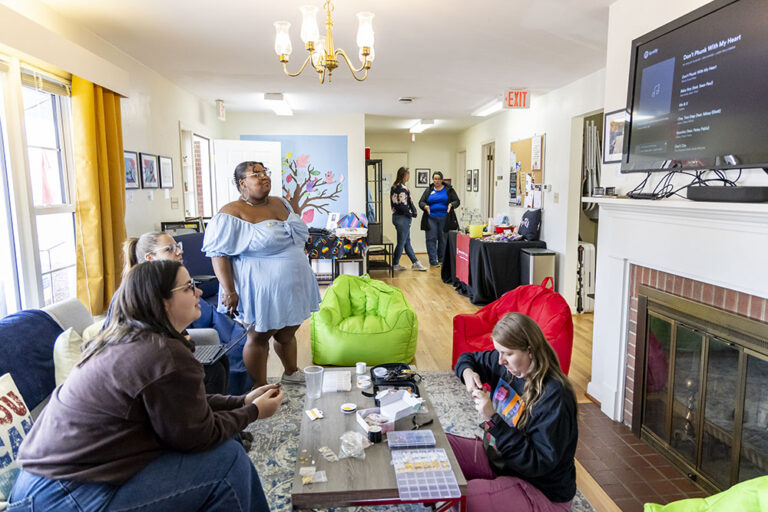
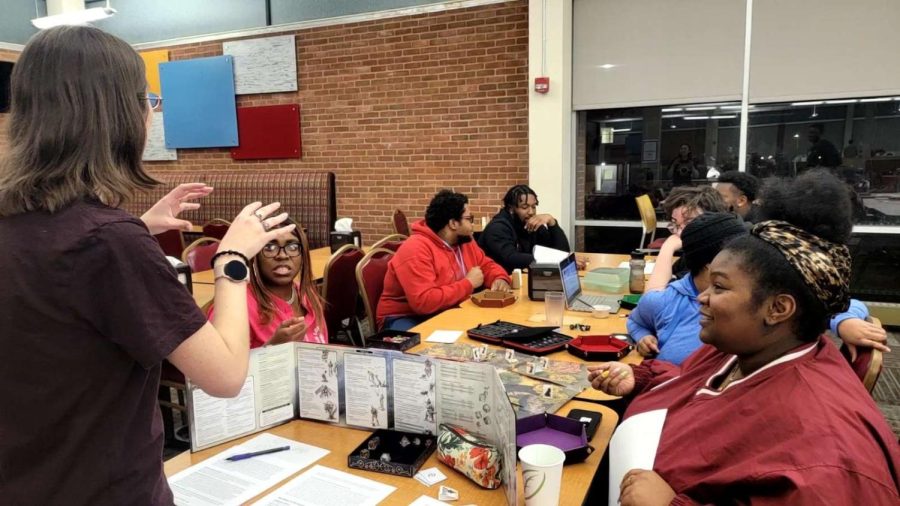
“The event we do the most is our improv nights,” Stanley said. “We’ll also do play readings where we’ll print out the script and just let everybody have fun reading a show.”
Emelyn Koene, a senior at Bridgewater College, said she enjoys that the club is hosting more events and that the club now has a really good team working to make these events happen.
According to the Daily Campus website, theatre clubs provide creative outlets for students to free their mind and connect them to the world around them. Having these creative outlets is proven to benefit students’ well-being and academics.
Stanley said they have a plan for a blood night on Feb. 10, which will be a workshop where participants will learn about applying and using stage blood.
“We’ll read scenes and then throw blood at each other – super fun!” Stanley said. “I think something that’s new and fun and exciting that people don’t really know about is a way to foster engagement.”
Anthony said that hosting these events helps students get introduced to theatre and get them involved
“I think the club helps kind of bridge the gap between casual and collegiate theatre,” Anthony said. “If you show up to the casual events and you’re like, ‘this is kind of fun, I kind of like this’ it can make it feel more approachable.”
Stanley said the club is up to 61 members, and the increased involvement expands the range of plays the club can do.
“We have more people auditioning for things,” Stanley said. “We have the capability to do bigger shows, which are usually more fun, so getting people in any way is super important to us.”